
The Many Arms of HR: Why the Role Has Never Been Harder
Recently, a friend and long-time connection, Riley Loftin (CFO), shared a sketch he made after years of working closely with HR and payroll teams.
The drawing captures something many leaders overlook: HR and payroll professionals operate like an octopus, often managing dozens of responsibilities at once while keeping the organization moving forward.
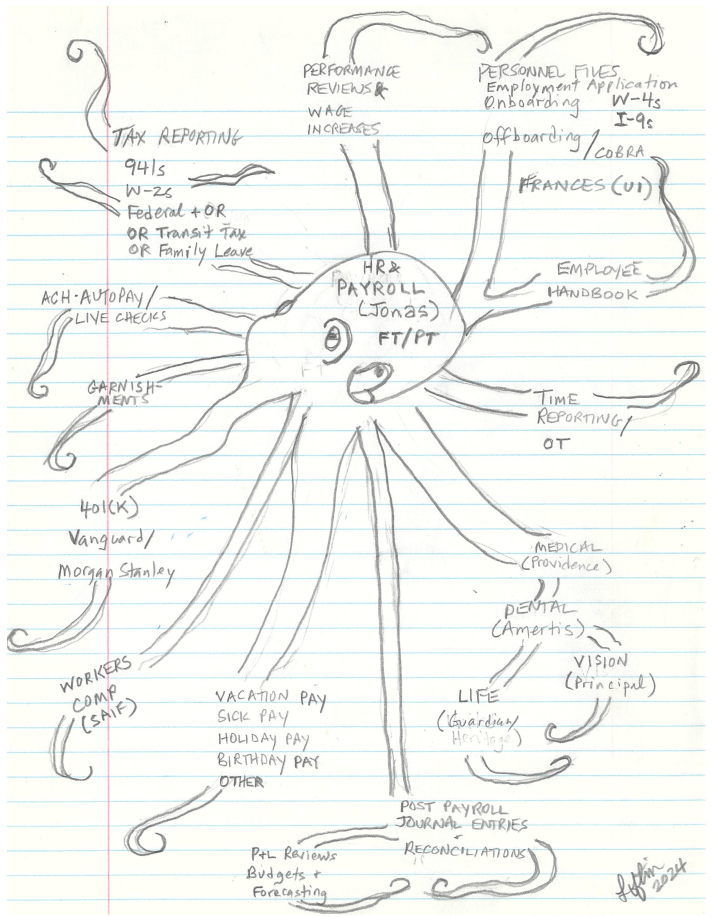
Art courtesy of Riley Loftin
At the core sits HR & Payroll, surrounded by an ever-growing number of responsibilities stretching outward like arms:
Tax reporting (941s, W-2s, federal and state requirements)
Payroll processing and ACH payments
Compliance with changing laws and regulations
Employee onboarding and personnel records
Performance reviews and wage increases
Benefits administration (medical, dental, vision, life)
Workers' compensation and retirement plans
Leave management and COBRA
Time tracking and overtime compliance
Employee handbooks and policy management
Budgeting, forecasting, and payroll reconciliation
Vacation, sick leave, and specialty pay policies
And the list goes on….
Most organizations rely on one or two people to manage all of it.
The Myth: HR and Payroll Are “Administrative”
Riley summed it up perfectly when he shared the drawing:
“This came from a CFO who got tired of hearing how ‘easy’ HR and payroll are. The hard part is doing it right - complying with ever-changing laws, treating both employer and employee fairly, and paying attention to details where small things matter. Those details can cumulatively save more money than most people realize.”
In other words, HR isn’t just administrative; it’s operational, financial, legal, and strategic all at once.
A strong HR leader must simultaneously understand:
employment law
compliance and reporting requirements
benefits strategy
employee relations
payroll systems
vendor management
financial implications of benefit decisions
And they must execute all of it while keeping employees engaged and leadership informed.
The Real Value of Great HR Leaders
A capable HR or payroll professional often creates significant ROI for an organization.
They prevent costly compliance mistakes.
They improve employee retention.
They streamline processes that save leadership time.
They catch financial inefficiencies before they compound.
As Riley noted:
“A good HR and payroll professional can easily create the ROI to justify their compensation. The great ones can execute their role while keeping all constituents happy.”
That is no small task.
Where Partnership Matters
The reality is that the benefits ecosystem alone has become a full-time specialty.
Health plans, pharmacy costs, compliance requirements, and funding strategies have grown more complex every year. Expecting HR teams to carry this expertise alongside everything else on their plate is increasingly unrealistic.
This is where partnership becomes essential.
At Tandem Benefit Partners, the goal is simple: stand beside HR leaders and help shoulder the complexity of benefits strategy.
Not replace HR.
Not add more noise.
But serve as a partner who helps bring clarity, structure, and long-term predictability to one of the most complicated areas HR manages today.
When the right partners work in tandem, HR leaders gain the space to focus on what they do best: Building strong teams and healthy organizations.
