
Alternative Funding: What Actually Matters When Evaluating Your Options
For many employers, conversations around health plan funding start in the same place: fully insured or self-funded? But in reality, It’s a spectrum of solutions.
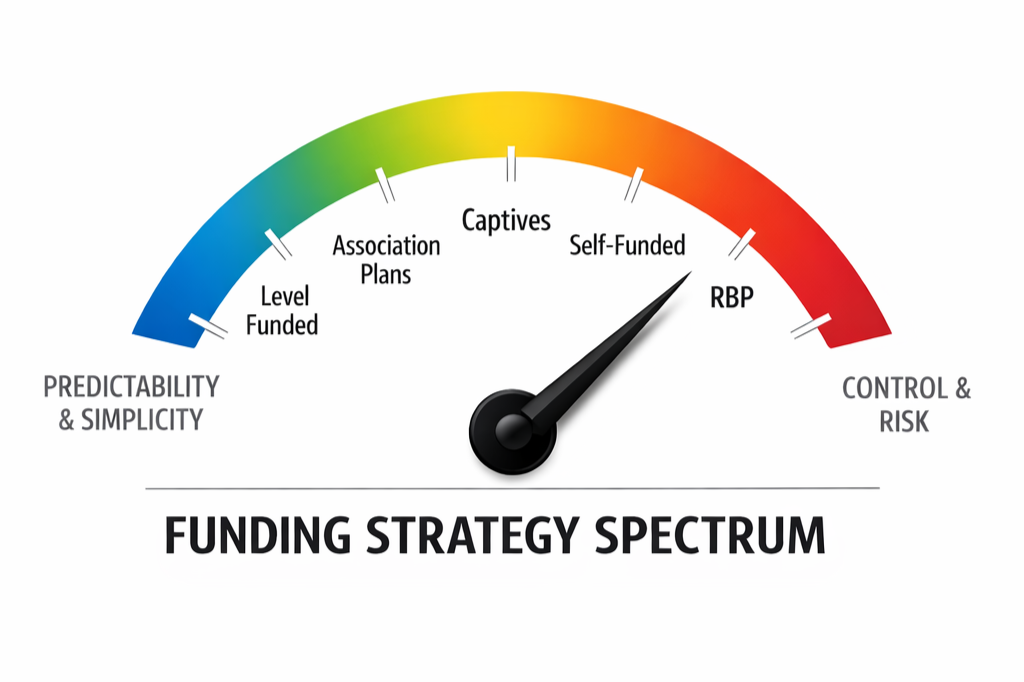
Each option introduces a different balance of risk, control, cost, and complexity. While some models prioritize predictability, others offer greater control and opportunity for savings but require more involvement and discipline over time.
Understanding that spectrum is the first step toward making more intentional decisions.
Fully Insured
For many employers, this is the most familiar approach.
Fully insured plans offer predictable with fixed monthly premiums. The carrier assumes the risk, manages compliance, and handles the majority of administrative responsibilities. This simplicity and structure can be appealing, particularly for organizations that value stability and minimal plan oversight.
That predictability, however, often comes at a cost. Fully insured plans typically include carrier risk margins, limited transparency into underlying claims, the carrier retains rebates, and less flexibility in how the plan is structured.
Association Health Plans
Association-based strategies allow employers to band together for purchasing power.
In some cases, this can create cost efficiencies and broaden access to alternative funding structures. The effectiveness of these arrangements, however, depends heavily on how they are structured and governed.
More recently, as interest in these models has grown, some have experienced increased volatility reinforcing the importance of understanding the underlying mechanics rather than relying on the concept alone.
Level Funded
Often considered a step toward self-funding, level funded arrangements blend elements of both models.
They introduce access to claims data, potential refunds when claims are lower than expected, and more flexibility in plan design. For many employers, this can be a meaningful entry point into understanding how their plan performs.
At the same time, level funded plans can still feel similar to fully insured in terms of cost if not actively managed. Stop-loss pricing, administrative fees, and pharmacy arrangements all play a role in determining whether the strategy delivers long-term value.
Self-Funded
Self-funded plans offer the highest level of control and with it, the greatest responsibility.
Employers pay for claims as they occur, rather than a fixed premium, and gain full access to their data. This transparency allows for more informed decision-making, targeted strategies, and greater flexibility in vendor selection and plan design.
With that control comes risk; claims volatility, stop-loss market conditions, and the need for financial reserves. Self-funding is rarely a short-term solution; it is a strategy that typically evolves over time as organizations build the infrastructure and confidence to support it.
Captives
Captives bring together groups of employers to share risk collectively.
When well-managed, they can offer increased stability, more predictable long-term outcomes, and access to data and strategies typically reserved for larger organizations. They also create a sense of shared accountability among participating employers.
Captives, however, come with their own kind of complexity. They require strong governance, alignment among members, and long-term commitment. While it’s often easy to enter a captive, exiting can be more challenging, making it important to evaluate carefully upfront.
Reference-Based Pricing (RBP)
Within self-funded strategies, employers can explore alternative approaches to how care is paid for like bundled, unbundled or even RBP.
Reference-based pricing moves away from traditional carrier networks and instead reimburses providers based on a multiple of Medicare. In certain markets, this can create meaningful cost savings and greater transparency or be unavailable completely in rural areas.
It also introduces complexity. Without a traditional network, providers may push back on reimbursement levels, and employees may need additional support navigating billing. Success with RBP depends heavily on communication, advocacy, and thoughtful implementation. It’s safe to say, it’s not for the faint of heart.
ICHRA (Individual Coverage HRA)
ICHRAs offer a fundamentally different approach.
Instead of sponsoring a traditional group plan, employers provide a defined contribution for employees to purchase their own individual coverage. This creates cost predictability and removes exposure to group renewal volatility.
At the same time, it shifts all the decision making and responsibility to employees. While this model can work well in certain situations, it may change how employees experience and perceive their benefits and can make it more difficult to return to a traditional group structure in the future.
What Actually Changes Across These Models
While each option has its own structure, the real differences come down to a few key factors:
Risk vs. Predictability: Alternative funding introduces variability but also opportunity.
Cost vs. Control: Lower long-term cost potential often comes with greater responsibility in managing the plan.
Data and Transparency: Access to claims data increases as you move along the spectrum, enabling more informed decisions.
Administrative Complexity: More flexibility typically means more moving parts; additional vendors, decisions, and oversight.
Long-Term Flexibility: Some strategies are easier to enter than exit, making it important to think beyond immediate savings.
Alternative funding isn’t a shortcut to savings, instead think of it as a shift in responsibility. Where do you want to shift that risk to?
The most effective strategies are built over time, with a clear understanding of an organization’s goals, financial tolerance, and operational capacity. What works well for one employer may not be the right fit for another.
Most employers don’t need more options, they need clearer guidance on which ones actually make sense.
If you’re ready to move beyond general conversations and into a more strategic evaluation of your funding approach, we’d be glad to help: info@tandembenefitpartners.com
