
AI in the Workplace: Opportunity, Responsibility, and the Future of HR
Artificial Intelligence has quickly become one of the most discussed workplace technologies in recent years. From drafting job descriptions to summarizing meetings and assisting with employee communications, AI has the potential to make HR teams more efficient than ever before.
For employers, the conversation should no longer be whether AI will become part of the workplace. It already has. The more important question is whether organizations are using it responsibly, and in a way that protects both employees and the organization itself.
The Compliance Questions Employers Should Be Asking
As organizations incorporate AI into everyday operations, governance and compliance become increasingly important. Federal, state, and local regulators are paying closer attention to how AI is used, particularly when it influences employment decisions.
Before implementing AI tools, employers should consider questions such as:
What employee information is being entered into AI platforms?
Does the platform retain or train on submitted data?
Is confidential company information adequately protected?
Have employees received guidance on acceptable AI use?
Are AI-generated documents being reviewed before being used?
For example, New York City's Local Law 144 requires employers using Automated Employment Decision Tools (AEDTs) in hiring or promotion decisions to conduct independent bias audits and provide notice to candidates. The Equal Employment Opportunity Commission (EEOC) has also issued guidance reminding employers that AI-assisted hiring practices remain subject to existing federal anti-discrimination laws, including Title VII of the Civil Rights Act.
Perhaps the most significant compliance consideration involves employment decisions. Hiring, promotions, discipline, and performance management require thoughtful human judgment. When organizations rely too heavily on AI-generated recommendations without understanding how they were developed, they risk introducing unintended bias, inconsistent decision-making, or legal exposure.
Recent litigation illustrates this growing focus. In Mobley v. Workday, Inc., a plaintiff alleged that an AI-driven hiring platform disproportionately screened out applicants based on race, age, and disability. While the case is ongoing, it demonstrates that courts are increasingly willing to examine how AI tools may affect employment outcomes.
Similarly, in EEOC v. iTutorGroup, Inc., the EEOC alleged that an automated hiring system unlawfully rejected older applicants based on age. The resulting settlement reinforced that automated hiring systems must comply with the Age Discrimination in Employment Act (ADEA).
Although technology may assist with decision-making, employers generally remain responsible for ensuring employment practices are fair, consistent, and compliant with applicable laws.
HIPAA and Protected Health Information
For organizations sponsoring employee health plans, healthcare providers, or organizations handling protected health information (PHI), AI introduces an additional layer of responsibility.
Entering protected health information into public AI tools could create significant privacy concerns if those platforms are not designed to meet HIPAA requirements.
Examples might include;
employee medical information
claims documentation
accommodation requests
leave administration records
other protected health information
Even when AI is used internally, organizations should understand exactly how information is processed, stored, and protected.
Without clear policies, well-intentioned employees may inadvertently expose confidential information or create compliance risks simply by trying to work more efficiently. Failure to safeguard PHI can result in significant penalties under HIPAA, including civil fines and reputational damage.
Employers should ensure that any AI vendor handling sensitive data signs a Business Associate Agreement (BAA) where applicable.
Practical Uses and Practical Risks
Organizations often ask: where is AI most useful, and where should we be cautious?
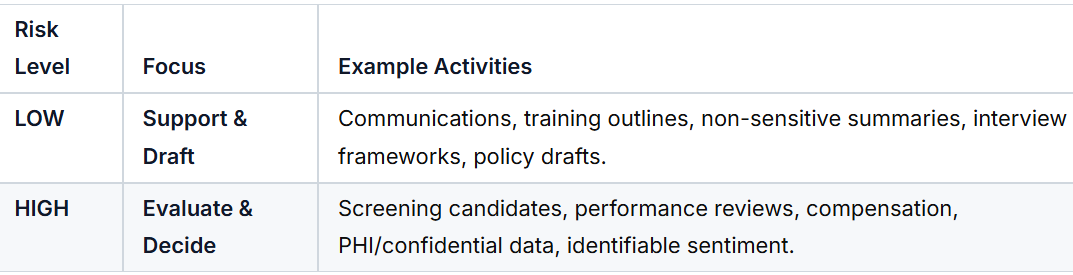
A practical rule: the more an AI tool influences employment decisions or handles sensitive data, the greater the need for human review and governance.
The Future of HR Is Not Less Human
One of the biggest misconceptions about AI is that it will replace HR professionals, when in reality the opposite is more likely.
As routine administrative work becomes increasingly automated, the importance of human leadership grows. Organizations will continue to rely on HR professionals who can:
Build trust
Navigate difficult conversations
Coach leaders
Support employees through organizational change
Exercise sound judgment in complex situations
Technology can improve efficiency, but it cannot replace empathy, ethical judgment, or organizational culture.
Moving Forward Thoughtfully
AI presents one of the greatest opportunities HR has seen in decades, but it also presents one of its greatest governance responsibilities.
Developing an AI Acceptable Use Policy is quickly becoming just as important as policies governing email, internet use, or cybersecurity.
Organizations do not need to fear AI, but they should approach it with the same care they apply to cybersecurity, employee privacy, compliance, and workplace safety. The organizations that will benefit most from AI are unlikely to be those that adopt it the fastest, they will be the ones that implement it thoughtfully, establish clear expectations, protect employee information, and keep people at the center of every workplace decision.
